

Do you have pain, numbness or a tingling sensation in your lower back, hip, buttocks or even travelling down your leg towards your foot? This could mean that your sciatic nerve is irritated or injured, giving you sciatica pain. Moving may feel very painful or uncomfortable and you may feel that you don’t want to move, but did you know bed rest can make the pain worse? Let’s explore how to relieve sciatica pain.
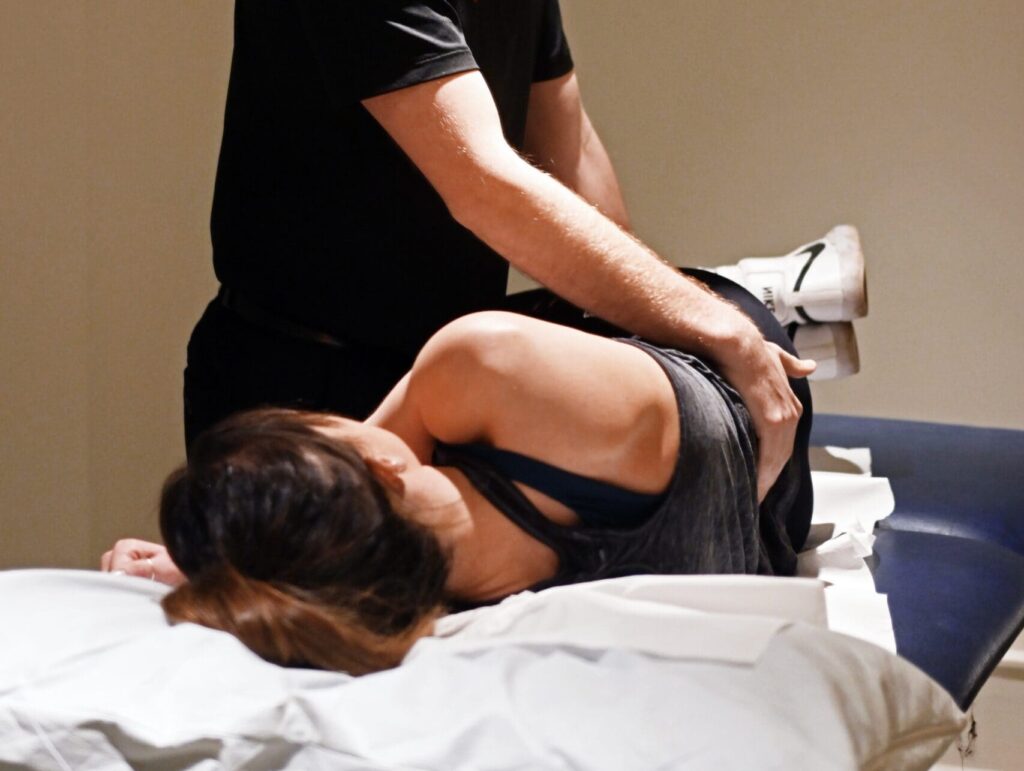
Do You Have Sciatica Pain?
Sciatica is when your body’s sciatic nerve gets hurt or irritated. This nerve goes from your lower back, through your hips and bottom, and down to your feet. When you have sciatica, you might feel pain, numbness, or tingling in these areas.
Sciatica isn’t a health condition by itself, but a sign that something else is wrong. An example of this can be a herniated disc (also known as a slipped disc).
Symptoms Of Sciatica Pain
If you are suffering from sciatica you may have one or more of the following symptoms:
- Pain, in the lower back, buttock, hip or pain going down the leg
- Pins and needles – tingling sensation down in the buttock, hip or travelling down the leg into your foot.
- Numbness, in the buttocks, hip or along the leg to your foot
- Weakness – You may feel the strength in your leg has changed
- You may describe the pain as a shooting, stabbing or burning sensation
Sciatica can range from mild to severe and is usually only felt down one side of your body. It can be made worse or aggravated by coughing or sneezing.
How To Relieve Sciatica Pain At Home
As sciatica is a symptom, we always advise seeking professional advice from an osteopath to diagnose the root cause of your sciatica pain. It’s important to stress that around 90% of people with sciatica pain get better within 4-6 weeks without medical intervention.
To Help Ease And Speed Up Your Recovery:
Keep Up Your Usual Activities:
You might think to rest and limit your movements… this may have even been said to you, but this is MYTH. Moving is probably the best thing you can do to help and ease your pain. Although movement may be painful, it’s important to note it doesn’t lead to more harm and can, in fact, aid in your recovery by:
- Boosting blood flow to the injured areas, which supports healing.
- Strengthening your muscles, which supports your spine.
- Increasing your flexibility and range of motion.
- Alleviating pain, by reducing the perception of pain.
This does not mean that you should endure extreme pain. Instead, try to avoid being seated or lying down for extended periods and move your body as much as you can without causing discomfort. Taking rest is also acceptable for the first few days, and you can slowly increase your physical activity as you go back to your regular routine.
We suggest following the Goldilocks Principle:
TOO Little/Easy (too Cold) –> Just Right <– Too Much/Hard (too hot)
Try Exercises For Sciatica:
Single Leg Back Stretch
Lie flat on your back, and bend your knee towards your chest. Hold this position and feel a gentle stretch in your back. If you get any groin pain while doing this exercise, stop and inform your therapist. Relax, and then repeat as necessary.
Hold for 10 seconds, repeat 5 times, 2 times daily
Lumbar Rotation
Bend your knees, and keeping your feet flat on the floor, rotate your hips to one side creating a rotation through your lower back. Only go as far as feels comfortable, you do not need to get your knees to the floor. Return to the opposite side. This is an excellent lower back mobility exercise, especially if you have acute lower back pain or disc problems.
Repeat 10 times, 2 times daily
Chair Rotation
Sitting down in an upright position, rotate your upper body by moving your hand towards the opposite side of the chair backrest. You can let the head follow, but progress by keeping the head straight forwards, thus making the rotation stronger. This is a great exercise to do while sitting for long periods of time if you feel your back is getting stiff.
Repeat 10 times, 2 times daily
Lumbar and Thoracic Side Flexion Standing
Stand up straight, and bend to the side by running your hand down the outside of your leg. Keep the movement slow and fluid. Repeat to the opposite side. This is a good mobility exercise for the lower and upper back.
Repeat 10 times, 2 times daily
Use Heat:
A hot water bottle can be very useful. We always advise you to wrap your hot water bottle in its sock or a tea towel. You can also use heat patches.
- For the first 2-4 days, use ice packs on the area that hurts to reduce inflammation of the sciatic nerve.
- Take care that the ice pack is wrapped in material and doesn’t directly touch your skin e.g. a pillowcase or tea towel.
- Leave it on for up to 10 minutes at a time.
- After four days, alternate between ice and heat packs several times a day as required, leaving at 10 minutes cold and 20 minutes hot.

When Should I See My Osteopath About Sciatica?
Sometimes, home treatments aren’t enough to relieve sciatica pain. You should see your osteopath if after a few days: you’ve felt no improvements in your symptoms, you feel symptoms are getting worse, or you are worried/ concerned about your symptoms. Your osteopath may refer you to other health professionals such as a GP doctor or neurologist.

At Body Beliefs, we pride ourselves on “exceeding expectations“, as evidenced by the glowing 5-star reviews from our satisfied patients on platforms such as Google Reviews and Facebook. To schedule an appointment, please book online or call 01277 676 676.

